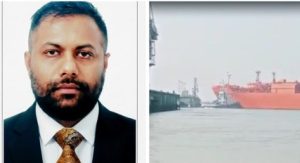
29 JAN 2026
Captain Asif Ahmed’s masterful ship-handling averts explosion that would have a catastrophic death toll, crippled critical infrastructure
A routine pilotage operation turned into a 60-minute fight for survival on Tuesday when a laden LPG carrier suffered complete engine failure while manoeuvring near the KAFCO Ammonia Jetty. Captain Asif Ahmed, Assistant Harbour Master of Chittagong Port Authority, brought the vessel within 1.2 meters of the structure before executing emergency manoeuvres that maritime officials say prevented a technological disaster of catastrophic proportions.
The Gas Harmony, a 160-meter vessel carrying 515 metric tons of propane and 4,570 metric tons of butane—over 5,000 metric tons of highly explosive liquefied gas—lost all propulsion at approximately 10:40 a.m. while navigating the confined 225-meter-wide Karnaphuli Channel. What followed was an hour of uncontrolled drift that placed the vessel on a collision course with an industrial jetty where 30 maintenance personnel were working.
“Dead Ship” in Living Danger
According to port officials and vessel logs, the main propulsion system failed without warning while Captain Asif was conducting pilotage duties. The vessel became what mariners call a “dead ship”—without engine power, steering, or means of self-propulsion—subject entirely to wind and current in one of the port’s most sensitive waterways.
Standard emergency protocols were executed immediately. Both anchors were deployed—starboard to three shackles on deck, port to two shackles—and attending tugboats applied maximum astern thrust. These measures, typically sufficient to arrest drift, proved inadequate against the forces acting on the 18,311-gross-ton vessel.
With the bow bearing down on the jetty, contact appeared inevitable.
The Maneuver
It was at this point, officials familiar with the incident report, that Captain Asif ordered an unconventional and counterintuitive action: heaving the starboard anchor—the vessel’s primary means of holding position—back onto the deck.
The maneuver altered the vessel’s drift pattern, swinging the bow away from the jetty. The Gas Harmony passed the KAFCO structure with just 1.2 meters to spare—a margin measured in mere meters against a vessel longer than a football field, carrying enough flammable gas to level the surrounding industrial zone.
The danger was not over. As the bow cleared, the port quarter swung toward the jetty. Captain Asif immediately adapted, halting the starboard heave and ordering the port anchor heaved to control the stern’s movement. Through this sequential, asymmetric use of the anchors—coordinated with tugboat assistance—the vessel was eventually brought to safe anchorage abeam of the United Tank Terminal Jetty, concluding the emergency at 11:40 a.m. without injury, environmental release, or structural contact.
Calculated Risk, Conscious Exposure
What distinguished Tuesday’s response, according to senior port officials who reviewed the incident, was Captain Asif’s sustained presence and direction of operations from the bridge throughout the 60-minute emergency.
With the vessel carrying over 5,000 metric tons of explosive cargo and positioned within meters of a collision that would have triggered immediate vapor cloud ignition, the bridge represented one of the most exposed locations in the port area. Maritime safety protocols acknowledge that in such scenarios, personnel may be required to evacuate non-essential positions. Captain Asif remained on the bridge, directing the bridge team and coordinating tugboat operations while the vessel’s position remained critical.
“These were not textbook conditions,” said one official familiar with the channel’s challenges. “Total propulsion failure in confined waters with that cargo profile—there is no standard procedure that guarantees outcome. The maneuvers executed required real-time adaptation under extreme time pressure.”
The Scenario Avoided
The consequences of contact between the Gas Harmony and the KAFCO Ammonia Jetty, as assessed by port safety officials, extend far beyond vessel and infrastructure damage.