08 MARCH 2026
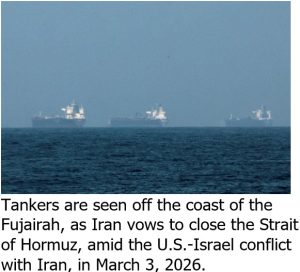
Recent vessel tracking data details the continued movements of Iranian dark vessels as well as other ships moving through the Strait of Hormuz.
Lloyd’s List Intelligence reports in addition to the Iranian shadow fleet moving post war, Greek affiliated ships are outnumbering the number of vessels traversing the Strait.
“The Greek affiliated vessels are loaded with oil within the Middle East Gulf, and now sailing towards the Strait of Hormuz,” explained Bridget Diakun Senior Risk and Compliance Analyst, Lloyd’s List Intelligence. “This is really critical, because if they’re able to go through without incident, this might encourage some other owners and operators to change their calculation and perhaps take the risk of moving. But again, this kind of depends on how things pan out and how long they are left waiting as more time drags on.”
Other vessels are linked to the UAE and a couple from China.
“There’s been a lot of talk China gets a free pass to go through the Strait of Hormuz,” said Diakun. “It’s not obvious in the data.”
Diakun explained Iranian loadings are still underway and movements of the sanction ships in the shadow fleet ships show the additional precautions being taken.
“Beyond disabling their AIS, we spotted a sanctioned container ship that was coming inbound to the Gulf. It ended up drifting waiting for three or four days before actually making the transit,” she said.
Lloyd’s List defines a properly confirmed dark vessel is one that has an official offline and online AIS duration.
At the start of the crisis, Lloyds List said between 40 and 50 ships went offline, mostly in the Middle East Gulf, and some at regional ports. Diakun expects those figures to be revised upwards in the coming days.
Nine dark transits have so far been traced by Lloyd’s.
About 80 percent of the transits being traced are dark transits.
“To be confident that a ship was actually transited while dark, you need the ship to come back online,” said Diakun. “So we don’t count anything we might suspect as a dark transit. We do have to get that proper confirmation.”
On March 4, an Iranian linked containership and a dark transit of a shadow fleet tanker heading out towards the Gulf of Oman were captured by Lloyd’s List.
Kpler data show the Iranian tankers are in the Gulf and showing no signs of a flight response. The majority of the tankers remain in or around the Strait of Hormuz and UAE/Omani anchorage zones.
“Movements suggest caution, low speeds, clustering, some drifting, but not a suspension of activity,” said Dimitris Ampatzidis, Senior Risk & Compliance Analyst at Kpler. “There is no clear sign of widespread unloading inside the Gulf over the last couple of days, which would be atypical for these trades anyway. In general, it’s typical that most Iranian crude discharge happens further east via ship-to-ship transfers or in Asia.”
Approximately 44 to 45 transits have gone through the strait since the start of the month, according to Lloyd’s List calculations. That is an approximate decrease of 90 percent in tonnage from normal levels.
The decrease in overall vessel transits has made way for a reversal in U.S. Russian oil purchases for India.
In a post on X, U.S. Treasury Scott Bessent announced India which imports around 90 percent of its crude with almost half coming from the Middle East has been granted a waiver to have the ability to buy Russian crude.
The decision was made to “enable oil to keep flowing into the global market” and that it will not “provide significant financial benefit to the Russian government.”
The reason behind this announcement is the limited amount of crude reserves the country has, because of the short transit time, the country only has a 30-day supply of crude.
South Korea, the leading provider for U.S. Jet fuel for the West Coast had an emergency meeting on Sunday to discuss on tapping into its petroleum reserves to keep domestic gasoline prices lower. Approximately 70 percent of South Korea’s crude imports pass through the Strait of Hormuz.