19 JAN 2025
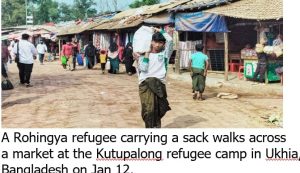
Refugees who escaped Myanmar nearly a decade ago await developments more than 8,000 kilometers (5,000 miles) away at the International Court of Justice (ICJ) in The Hague, where a genocide case against Myanmar opened on Jan 12.
The International Court of Justice (ICJ) in The Hague has heard that Muslim Rohingya were “targeted for destruction” by hate campaigns through fake Facebook accounts ahead of a widespread 2016-17 crackdown by Myanmar’s military that resulted in a genocide.
Public hearings continued on Jan. 13 after lawyers countered Myanmar’s argument that the number of people killed was relevant to whether or not the act of genocide had been committed, saying this “was wrong” and that it had no legal basis in genocide law.
Lawyers spent much of Jan. 13 focusing on efforts by the military, or Tatmadaw, to manipulate the public through “anti-Rohingya hate propaganda” via fake Facebook accounts, which was part of a “systematic campaign” run by hundreds of military operatives.
Arsalan Suleman, representing Gambia, told the court inside the Peace Palace of The Hague, the propaganda campaign reached millions of people, and his legal team had identified six themes of Myanmar’s anti-Rohingya hate rhetoric.
He said these included: “A denial of Rohingya identity as a distinct ethnicity and or as natives of Myanmar. Portrayal of the Rohingya as an existential threat to Myanmar. Portrayal of the Rohingya as a threat to racial purity of the recognized Myanmar ethnic people.”
Further, he said in hearings broadcast online, was the “portrayal of Islam as a threat to Buddhist sanctity,” which justified the denigration and suffering of the Rohingya, which was followed by the portrayal of these crimes as fabrications.
“These are in large part the same themes, dehumanization, accusations in a mirror, and threats to racial purity that Myanmar and the Tatmadaw have been propagating for many years,” he said.
After years of legal wrangling, efforts to prosecute military chief Gen. Aung Ming Hlaing and senior brass for the alleged genocide moved from the preliminary stage to the merits phase, where the first witnesses and expert public testimonies from both sides are heard.
Following the merit phase, the ICJ moves beyond procedural questions where it decides who is right or wrong under international law.
Judges must decide if Myanmar had breached its obligations under the 1948 Convention on the Prevention and Punishment of the Crime of Genocide after a case was lodged in the ICJ by Gambia in November 2019, with support and written submissions from 11 countries.
“By all measures, this case is not about esoteric issues of international law,” Gambia’s Attorney General and Justice Minister Dawda Jallow told the court. “It is about real people, real stories, and a real group of human beings.”
He said his country brought the case “after reviewing credible reports of the most brutal and vicious violations imaginable” committed against the Rohingya.
About 1.5 million Rohingya fled abroad, with more than 1.1 million of them crossing Myanmar’s land border into Bangladesh after a crackdown was launched in two phases by the military, which it said was in response to attacks on police outposts by local militias.
The first phase lasted from Oct. 9, 2016, to Jan. 17, 2017. The second began on Aug. 25, 2017, and continues to the present day. At least 24,000 people died, villages were plundered and destroyed, and tens of thousands of women were raped in Western Rakhine state.
Those crimes were allegedly committed when Nobel Laureate Aung San Suu Kyi was in power; however, she was ousted in a coup d’etat in early 2021, tipping the country into a bloody civil war, and she remains in prison. Aung Hlaing is currently holding elections widely discredited as a sham.
Suu Kyi has previously dismissed Gambia’s arguments as a “misleading and incomplete factual picture” of what she said were the unfortunate results of an “internal armed conflict.”
A fact-finding mission mandated by the UN Human Rights Council in 2018 found there were reasonable grounds to conclude that serious crimes, including genocide, crimes against humanity, and war crimes, were committed. Some countries have argued it was ethnic cleansing.
ICJ President, Iwasawa Yuji, has scheduled two rounds of pleadings, each from Gambia and Myanmar, to be held alongside closed sessions when testimony from witnesses will be heard. ICJ hearings are expected to conclude on Jan. 29.
The ICJ settles legal disputes between states, provides opinions on international law, and the court’s findings are legally binding. Unlike criminal courts, it does not try individuals but determines state responsibility.
Source: https://www.ucanews.com/news/icj-told-myanmar-military-hate-campaigns-targeted-rohingya-for-destruction/111564