18 NOV 2025
A panel of leading shipowners called for the International Maritime Organization (IMO) to take a pragmatic approach to regulating the shipping industry’s greenhouse gas emissions, warning that there would be global economic consequences for getting it wrong.
Decarbonisation may take longer than hoped for, but the stakes are high in shipping’s energy transition, panel says.
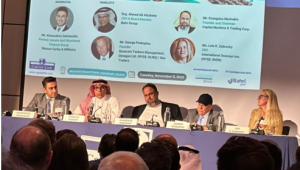
Speaking at the Capital Link Maritime Forum in Dubai, Eng. Ahmed Ali Alsubaey, CEO & board member, Bahri Group, said shipping’s own pragmatism was good for the environment and the world as a whole. The IMO should take a similarly practical approach, as global industry would screech to a halt if shipping took a wrong step in its energy transition, he said.
“The shipping industry, you don’t know how powerful you are. When we sneeze, the rest of the industries get a cold. We’ve seen it,” he said. Alsubaey listed the pandemic, Russia-Ukraine war, and US-China trade war as examples of how disruption to shipping has rippling global effects that reach the man and woman on the street.
Lois Zabrocky, CEO, International Seaways Inc., said she believes that the shipping industry is pragmatic, and that it will decarbonise, although the practicalities may take longer than “the dreamers” want. Shipowners face a challenge in making considered investments — close to $150m for a dual-fuel LNG VLCC out of South Korea — on environmental credentials for alternative fuels that can be unclear and are shifting.
George Prokopiou, founder, dynacom tankers management, said that fuel-ready notations for vessels are a marketing tool. “What we do as ship owners, we are ordering the best available ships at the given moment. We don’t go and say, ‘give me a model that is 10 years old’.”
Shipowners have taken risks in ordering more efficient tonnage with less proven technologies such as new engines, said Prokopiou, and that had resulted in modern tonnage with 30-35% lower fuel consumption for the same cargo. Ship efficiency is a rare place where shipowners and green organisations are aligned, he said, as fuel is a major cost in ship operations, and owners want to keep costs low.
Alsubaey agreed, saying the industry bears no resemblance to how it was in the 1960s, especially when it comes to fuel and engines. “The two major industries that have done something about the environment are the energy sector and the designers of [engines]. These two groups, over the last 30-40 years, have really transformed what we do,” he said.
The panel were less optimistic about the transformational potential of the IMO’s Net Zero Framework (NZF), which was recently delayed at a meeting of the Marine Environment Protection Committee (MEPC).
Prokopiou said he believes there is a fundamental problem with a lack of clarity on the distribution of funds raised under the proposed rules, and that the IMO is set up as a regulator, not a tax collector. He had clear reservations on timescale and ambition too: “When you penalise somebody for not using fuels that don’t exist, it’s absurd,” he said.
Evangelos Marinakis, founder and chairman, Capital Maritime & Trading Corp quipped that paying a levy on fuel to governments in Europe was a roundabout way of tackling the issue at hand. “We don’t solve the problem for our environment. It’s like you pay someone and you die happier, it doesn’t make sense.”
Marinakis compared carbon taxation unfavourably to a more familiar strategy used in shipping.
“With slow steaming, there is a result. There are less emissions, and the only thing that is increasing is the time of transportation. But at the end of the day, you see a result that helps the environment.”
Far from cutting costs, suezmaxes cost around $70m – $80m, and for the lifespan of a newly-delivered vessel there is the prospect of paying penalties of up to $240m under NZF, claimed Prokopiou. No shipowner can foot such a bill, he said, and the cost would ultimately fall to consumers and drive up inflation and poverty.
Related:John McDonald to succeed Chris Wiernicki as ABS chief
Prokopiou suggested that shipowners and operators are the wrong target for regulation. “We are not the engine builder, not the shipyard. We are the taxi drivers. We are the users… We are not the fuel makers, the refineries and the energy companies are.”
On the challenge of alternative fuel infrastructure, Prokopiou said shipping needs two fuel suppliers in each port, “because if you have one supplier, he’ll screw you on the price”. Once that distribution system is in place, shipowners will use it but it is not their job to build it. “We buy whatever is the best available,” he said.
Alsubaey raised the issue of environmental regulation with unintended consequences, noting one impact of the drive to lower sulphur content in marine fuels. “I never liked those open ended scrubbers. I thought it’s a joke. If anybody thinks we’re doing this for the environment, I don’t know what science they have been reading, to take pollution from the air and put it in the sea and get it into the food cycle.”
“The reason we’re doing it… [is] because it makes economic sense, not because it makes environmental sense. I hope that we don’t get [decarbonisation] regulation that, on the face of it, looks environmental, but actually it is more harmful to the environment,” said Alsubaey.
Considering the next steps for NZF at IMO, Marinakis said he’d like to see compromise and an agreement on measures that have an immediate effect on the environment. “We have a year in front of us, at least, to make some constructive discussion and find the solution.”
Alsubaey said: “I’m hoping that the next time IMO meets, they will come up with something pragmatic, something possible, something we can do so we can truly, truly show our love for this blue planet.”
Prokopiou echoed the sentiment: “We are a family company. We try for the best. We care for our children and our grandchildren, to live in a better environment, but we go with the possible, not the desirable.”
Despite the issues raised with the NZF, the panel were responsible for sizable investments in greener tonnage. Marinakis said a significant premium was paid to order more than 30 vessels as dual-fuel LNG, but the business case made sense, as well as the environmental benefits.
“When the market on LNG is stabilised, and the new production comes in, the price of LNG will be lower, and of course, it will make sense to consume LNG irrespective of the reduction in emissions,” said Marinakis.